How each type works
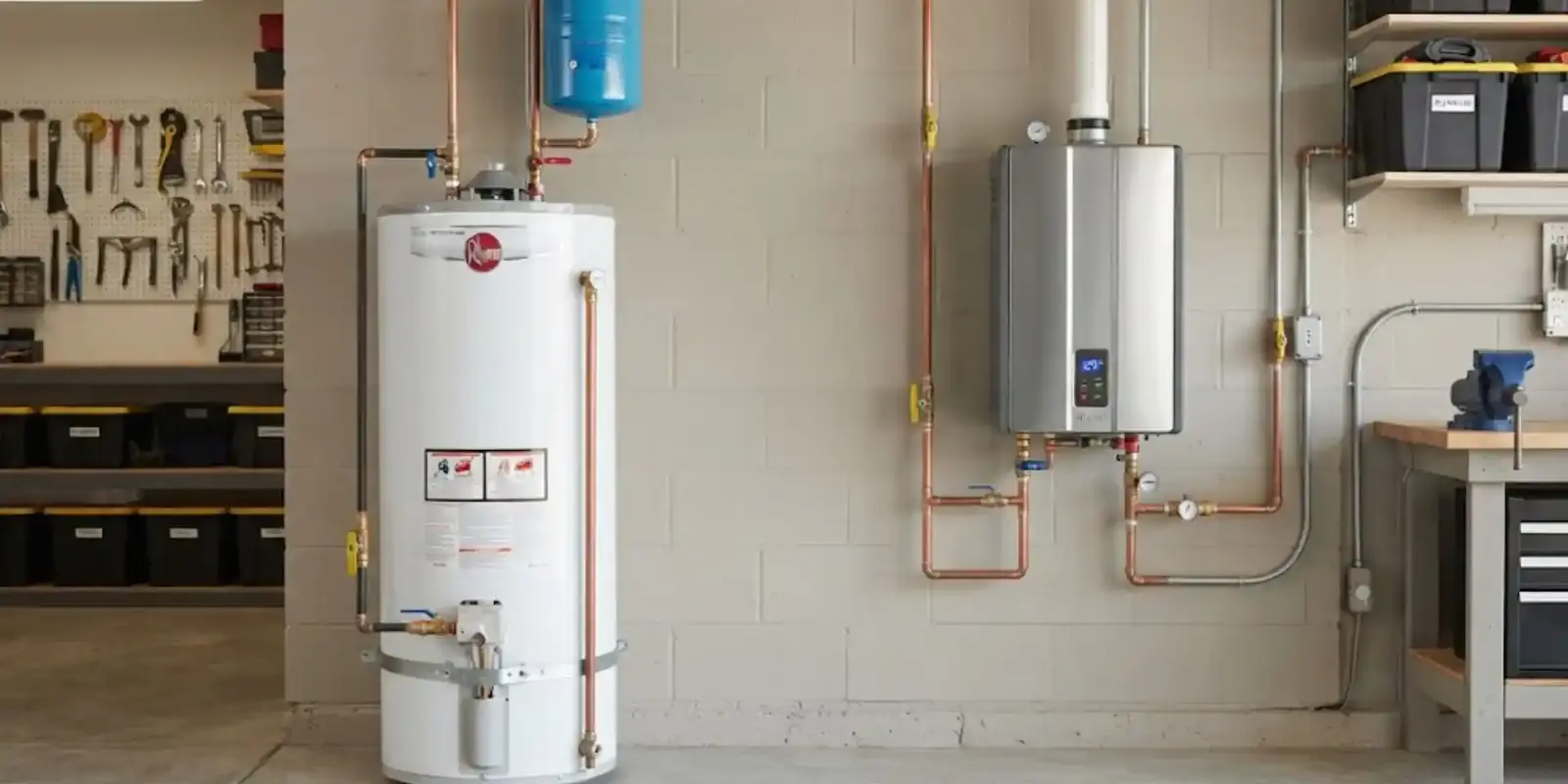
A tank heater stores forty to fifty gallons or more and keeps it hot all day. A tankless heater has no storage, and it heats water only when you open a tap.
That difference drives almost every tradeoff between them, from space and running cost to what happens when two showers run at once.
Code and standards
The California Plumbing Code, which is based on the Uniform Plumbing Code (UPC), applies to both types, and manufacturer instructions control gas sizing and venting for a tankless unit.
Side by side
| Factor | Tank | Tankless |
|---|---|---|
| Hot water supply | Limited by tank size | Continuous, limited by flow rate. |
| Space | Needs floor space | Wall mounted, compact. |
| Installation | Simpler for a swap | May need larger gas line and vent changes. |
| Maintenance | Flush the tank, check the anode | Descale the heat exchanger. |
| Lifespan | Often 8 to 12 years | Often longer with maintenance. |
California specifics
Rules that apply here
California requires water heaters to be braced against earthquake movement, under Health and Safety Code section 19211, and replacement generally needs a permit. Ask the City of Rosemead building division about its current process before you start.
What a switch involves
Moving to tankless is more than swapping a box. Gas burners in tankless units need more fuel at once, so the gas line and meter may need work. Vent materials are different, and the wall location must allow it.
We check the gas capacity, the vent route and your water pressure before we quote. See tankless water heaters for details.
Hard water and upkeep
Check your provider's water quality report for hardness. Hard water scales both types, and tankless heat exchangers lose efficiency faster when scale builds. A water softener helps both.
Tank owners should flush yearly and check the anode rod. Tankless owners should descale on a schedule the maker recommends.
Running costs and what to expect
Operating cost depends on fuel price, how much hot water you use and how the unit is set up. A tank loses a little heat all day through its walls and flue, which is called standby loss. A tankless unit avoids that loss but fires harder when you open a tap.
For a household that uses hot water in short bursts, tankless often uses less energy. For a household that runs hot water almost constantly, the gap narrows. Neither type wins in every home, so be wary of any claim that does not ask about your habits.
Ask the installer to explain the unit efficiency rating and the expected annual running cost on your own gas or electric rates.
Which one fits you
Large family, back to back showers
A bigger tank or a larger tankless unit can both work, so look at flow needs.
Small home, limited space
Tankless saves floor space.
Tight budget for a quick swap
A tank is usually simpler and cheaper to install.
Long term plan to stay
Tankless may pay off over time if the install is straightforward.
For installation details see water heater installation and our team in El Monte and Montebello can discuss both options.
Comfort and daily use
A tank gives you a fixed reserve. Once the reserve is gone, you wait for it to recover, which can happen on a morning when everyone showers. A tankless unit never runs out, but if two showers and a dishwasher demand more flow than the unit can heat, the water temperature can drop.
There is a small delay with a tankless heater before hot water reaches the tap. Some homes add a recirculation loop to cut the wait and save water that would otherwise go down the drain.
Noise is another difference. A tank is quiet apart from occasional pops from sediment. A tankless unit has a fan and burner that you can hear if the wall is shared with a bedroom.
Quick decision guide
- Choose a tank if you want the simplest swap and a lower upfront cost.
- Choose tankless if floor space matters and your gas line and vent can support it.
- Choose a larger tank or two units if many people shower at once.
- Add a softener if your water report shows high hardness.
When in doubt, have a plumber look at the gas line, vent route and water pressure before you decide. Those three items settle most questions.
Planning around a failure
Most people choose a water heater under pressure, after the old one has already leaked. If your tank is more than about ten years old, think about the choice before it fails, so you can compare options without a cold shower deadline.
Ask a plumber to look at the age, the anode rod and the base of the tank, and to tell you honestly how much life is left. That gives you time to plan, to get a written price and to schedule the work on your terms.
Questions to ask before you decide
What size do I need?
Count the fixtures that run at the same time and add up the flow rate.
What will the install involve?
Ask about gas line size, venting route and any electrical work.
What maintenance is needed?
Ask how often to flush a tank or descale a tankless unit.
What is the warranty?
Compare the tank warranty and the heat exchanger warranty in writing.
Questions people ask
They can lower standby energy use, but savings depend on your habits and installation cost.
Yes if the unit is sized for it. A smaller unit may struggle.
Often yes, because tankless burners draw more gas at once.
Tanks must be strapped. Wall mounted tankless units are secured to the wall.
They can cut energy use but need space and airflow.
Still unsure? Call (626) 898-6169 and a dispatcher will talk it through with you.
Want a plumber to look at it?
Call (626) 898-6169 any hour. We book same-day appointments when available, with a clear price before work starts.
Call (626) 898-6169